
A party wall agreement is the written consent, or the formal surveyor’s award, that lets you carry out building work affecting a shared wall, boundary or nearby foundations. It is required under the Party Wall etc. Act 1996 for most rear extensions, loft conversions and basement projects in London. You serve a notice on your neighbour, who has 14 days to respond. If they consent in writing, no surveyor is needed. If they dissent or do not reply, a surveyor prepares a party wall award. The person carrying out the work pays the reasonable surveyor fees, typically £900 to £1,500 for a single agreed surveyor in London.
If you are planning an extension or loft conversion in London, there is a good chance the Party Wall etc. Act 1996 applies to your project. Most terraced and semi-detached homes share a wall with a neighbour, and any work that affects that wall, the boundary, or the ground near your neighbour’s foundations brings the Act into play.
This guide explains what a party wall agreement is, when you need one, the notices involved, how long the process takes, what it costs in London in 2026, and who pays. It is written for homeowners, not surveyors, so we have kept the legal language to a minimum. At Build Team we have guided more than 500 London homeowners through the party wall phase of their projects over the past 15 years, so the examples here come from real work across the city.
What is a party wall?
The Party Wall etc. Act 1996 gives the term a specific meaning. A wall is a party wall if it stands on the boundary between two properties and forms part of one building, if it belongs to one owner but separates two buildings, or if it stands on one owner’s land but is used by both to separate their buildings. Floors and ceilings between flats are also party structures.
Garden fences and hedges are not party walls. A masonry wall between two gardens can be a party fence wall, which the Act also covers. The Act applies in England and Wales, and came into force on 1 July 1997.
What is a party wall agreement?
A party wall agreement is the written record that sets out how work affecting a shared wall or boundary will be carried out. In everyday use the term covers two things:
- Written consent. If your neighbour agrees to your notice in writing within 14 days, that consent is the agreement, and no surveyor is needed.
- A party wall award. If your neighbour dissents or does not reply, a surveyor prepares a formal document called an award. It sets out the works, how and when they will be done, access arrangements, and a record of the neighbour’s property before work starts.
The two terms are often used to mean the same thing. Strictly, the agreement is the neighbour’s consent, and the award is the formal document a surveyor produces when there is a dispute.
When do you need a party wall agreement?
You need to serve a party wall notice, and potentially reach an agreement, when your work falls under the Act. The three most common triggers for London extensions and loft conversions are work on an existing party wall, building a new wall on the boundary, and excavating near a neighbour’s foundations.
Work on an existing party wall covers cutting in steel beams for a loft conversion, removing a chimney breast, or building up against the shared wall for a rear extension. On our wraparound extension and loft conversion in SE13, for example, the loft conversion required steels to be set into the party wall, which is exactly the kind of work the Act covers.
Building a new wall on or up to the boundary is common on side return and infill extensions, where a new flank wall sits right on the boundary line. Our side return extension in East Dulwich and our side infill extension in N15 both involved building along the boundary shared with a neighbour.
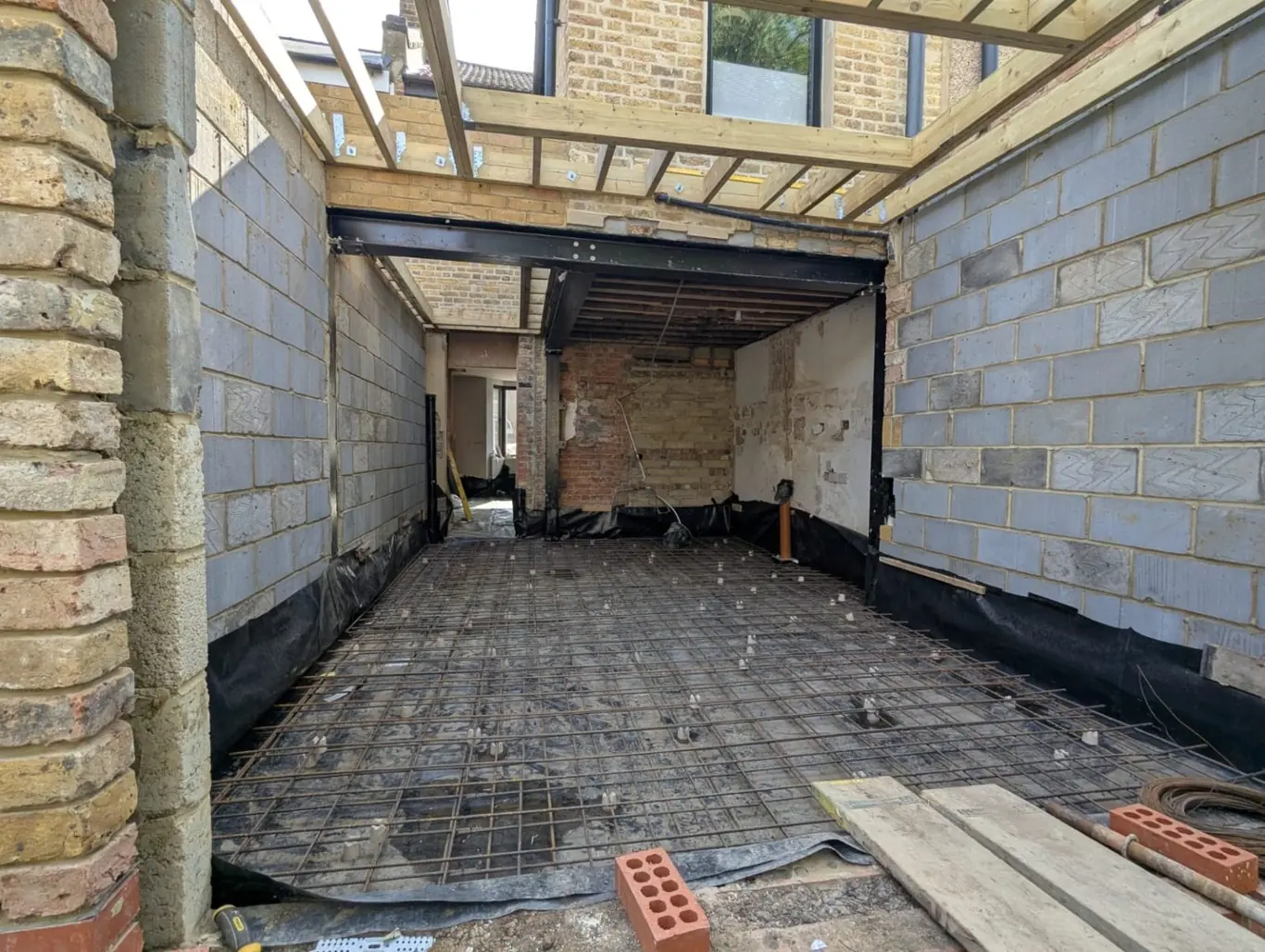
Excavating near a neighbour’s foundations applies when you dig within three metres of a neighbouring building and deeper than its foundations, or within six metres in certain cases. This covers most extension foundations and all basement work. Many London projects trigger more than one of these at the same time.
Minor jobs do not need a notice. Putting up shelves, replastering your side of the wall, or fitting units does not fall under the Act.
The three types of notice and their timelines
The Act sets out how much notice you must give your neighbour before work begins. These are legal requirements, not guidelines, and serving the wrong notice or none at all can halt your project.
| Notice | When it applies | Notice period |
|---|---|---|
| Section 1 Line of Junction |
New wall on or astride the boundary | 1 month |
| Section 2 Party Structure |
Work to an existing party wall, such as inserting beams or removing a chimney breast | 2 months |
| Section 6 Adjacent Excavation |
Excavation within 3 to 6 metres of a neighbour’s foundations | 1 month |
A notice must be in writing, give your name and address, describe the work, and state when you intend to begin. A notice is only valid for 12 months, so it is worth serving it two to three months before your planned start date, not earlier.
The party wall process, step by step
- Serve the notice. You or your surveyor serves the correct notice on every adjoining owner, including freeholders and long leaseholders.
- Wait for the response. Your neighbour has 14 days to reply. They can consent in writing, dissent, or not respond.
- If they consent, the process is complete and you can proceed. Many surveyors still recommend a schedule of condition to protect both sides.
- If they dissent or do not reply, a dispute is deemed to have arisen. A 10-day letter can be sent requiring your neighbour to appoint a surveyor. Both owners can agree to use one impartial surveyor, or each can appoint their own.
- The surveyor prepares the award, along with a schedule of condition, and work can begin once it is served.
Agreed surveyor or two surveyors?
If your neighbour dissents, the cheapest route is an agreed surveyor: one impartial surveyor who acts for both owners. If your neighbour insists on their own surveyor, you pay for both, and the two surveyors select a third to settle any deadlock. Talking to your neighbour early and encouraging an agreed surveyor is the single most effective way to keep costs down.
What is a schedule of condition?
A schedule of condition is a dated, photographic record of your neighbour’s property before work starts. If a crack or a mark appears later, the schedule shows whether your works caused it. It protects you as much as your neighbour, and for that reason it is worth having even when your neighbour consents.
How much does a party wall agreement cost in London?
Party wall costs are not fixed by law and vary with the number of neighbours, whether they consent or dissent, and whether one or two surveyors are appointed. If your neighbour consents in writing, your only cost may be preparing and serving the notice. Where a surveyor prepares an award, a single agreed surveyor in London typically costs between £900 and £1,500. The figures below reflect typical London rates in 2026.
| Item | Typical London cost (2026) |
|---|---|
| Notice preparation and serving | £20 to £150 per notice |
| Schedule of condition | £300 to £600 per neighbouring property |
| Party wall award (single or agreed surveyor) | £700 to £1,500 |
| Agreed surveyor, whole matter | £900 to £1,400 plus VAT |
| Third surveyor (dispute resolution) | £200 to £300 per hour, usually shared |
As a rough guide by project type, a single-surveyor party wall matter tends to settle around £1,575 for a loft conversion, £2,025 for an extension, and £3,375 for a basement, with London figures at the higher end. Where both parties appoint separate surveyors, costs can roughly double. Party wall fees sit alongside the other costs of your project, which we cover in our guide to how much an extension costs in London.
Build Team’s fixed-fee party wall service. Rather than open-ended hourly rates, we quote a fixed fee up front so you know the cost before any notice is served. Our service includes the serving of two notices, ongoing support, and where needed a full schedule of condition prepared by our RICS-approved surveyor.
Who pays for the party wall surveyor?
In almost all cases the building owner, the person carrying out the work, pays the reasonable fees of all surveyors involved, including your neighbour’s surveyor if they appoint one. Your neighbour rarely pays anything, unless they cause unnecessary work or appoint a surveyor for matters outside the Act. This is because you are the one asking them to go through the process.
What happens if you do not serve notice?
Serving notice is a legal requirement, not a courtesy. If you start notifiable work without serving notice, your neighbour can apply to the court for an injunction to stop the work, sometimes within a day or two. Without a schedule of condition, it is very hard to establish which damage your works caused and which was already there, so you may be liable for repairs you did not cause. Serving notice properly protects you as much as your neighbour.
How a party wall agreement fits into your wider project
A party wall agreement is one of three separate legal steps for a London extension or loft conversion, and each is dealt with on its own:
- Planning. Whether you can build. Many extensions and loft conversions fall under permitted development, though some need full planning permission, particularly in conservation areas such as the one in our side and rear extension in a conservation area in SE24.
- Building regulations. How you build it safely. Almost every extension and loft conversion needs building regulations approval, even when it is permitted development.
- Party wall. How work affecting a shared wall or boundary is managed with your neighbour.
Satisfying one does not satisfy the others. Getting planning permission does not remove the need for a party wall agreement, and reaching a party wall agreement does not remove the need for planning permission or building regulations.
“Most homeowners are surprised that a loft conversion or a rear extension needs a party wall notice at all. Getting it right early, with the correct notice and a schedule of condition in place, is what keeps a project moving and avoids disputes once the builders are on site.”
[Gustavo Cilumbriello, Build Director]
Planning an extension or loft conversion?
Build Team’s fixed-fee party wall service takes care of the legal side, from serving notices to preparing the award, so your project stays on track.
Party wall agreement FAQ
Do I need a party wall agreement for an extension?
Usually yes, if the extension involves work on a shared wall, a new wall on the boundary, or excavation near your neighbour’s foundations. A single-storey rear or side return extension on a terraced or semi-detached home almost always falls under the Act. A detached home set well away from the boundary may not.
How long does a party wall agreement last?
A party wall notice is valid for 12 months. If work has not started within that period, the notice must be served again. This is why it is best not to serve notice too early.
Who pays for the party wall surveyor?
The building owner carrying out the work normally pays all reasonable surveyor fees, including the adjoining owner’s surveyor if one is appointed. Your neighbour rarely pays anything.
Can my neighbour refuse a party wall agreement?
Your neighbour cannot stop work that the Act allows. If they dissent, the process simply moves to a party wall award prepared by a surveyor, which sets out how the work proceeds. Dissent does not end your project.
How long does the party wall process take?
If your neighbour consents in writing, it can be resolved within the 14-day response period. If a surveyor is appointed, preparing the award usually takes a few weeks. Starting early, two to three months before work begins, avoids delays.
What is the difference between a party wall agreement and a party wall award?
A party wall agreement usually means your neighbour’s written consent to your notice. A party wall award is the formal document a surveyor prepares when there is a dispute, setting out how and when the work will be done and recording the condition of the neighbour’s property.